
Jury Service
The right to a trial by jury is a cornerstone of American democracy, guaranteed by both the State and Federal Constitutions. The administration of justice is not a process in which shortcuts should be made simply to speed up the process. The determination of truth and the fair and equitable application of the laws are important.
When serving on a jury, you have the privilege of providing direct input into the administration of justice. You will find your participation as an officer of the court to be both interesting and educational.
This site provides general statewide information about jury service. To get answers to specific questions about jury service in your county, please contact your local jury commissioner. In most cases, the Clerk of the District Court serves as the Jury Commissioner. If the Clerk of the District Court doesn't serve as the Jury Commissioner, he or she will know who does.
There are two types of juries in Nebraska:
- Trial Jury. A trial jury is sometimes known as a petit jury. The trial jury decides both criminal and civil cases and may consist of 6 or 12 members. These jury trials take place in the courtroom, in the presence of the judge, the jury, the attorneys and the public. In a criminal case, a person accused of a crime may confront witnesses and may be convicted only when each juror is convinced of guilt beyond a reasonable doubt. In a civil case, a trial jury decides whether the plaintiff has provided enough evidence that it is more likely than not (preponderance of the evidence) that the defendant injured the plaintiff in some way that requires compensation. The Jury Trial section below has more information on the process of a trial jury.
- Grand Jury. The function of a grand jury is entirely different than the trial jury. It consists of 16 members and 3 alternates whose functions are conducted in secrecy. The grand jury has the responsibility to investigate charges of crimes and, if the investigation warrants, to make an accusation against an individual by returning an indictment against the person. The decision to indict is normally made solely on the basis of the state’s evidence without the accused person having the opportunity to present his or her side of the case. The Grand Jury section below has more information on the process of a grand jury.
Jury Selection
You were selected to serve on a jury from a county voter registration, state I. D., or driver’s license list. An impartial, random method of selection from these lists is required by law.
To qualify as a juror you must:
- be a United States citizen
- be 19 years of age or older
- be physically and mentally capable
You may be disqualified from serving on a jury for the following reasons:
- If you have been convicted of a felony when the conviction has not been set aside or a pardon issued
- If you are a judge, clerk of a district court, a sheriff, or a jailer
- If your spouse has been summoned for the same jury panel
- If you or your spouse have a pending jury trial in any court
You may be excused from serving on a jury
If you intend to request to be excused from jury service for any reason, immediately notify the clerk of the court who has summoned you in writing. Your request will be reviewed by a judge.
You are not required to serve when called for jury duty if within the past 5 years you have served as a petit juror for more than 4 weeks, served on more than one grand jury, or served on both a grand jury and a petit jury.
Individuals who are 70 years or older can be exempt from jury services by submitting a written request.
Jury service may be postponed by the judge if you can submit a written request and show undue hardship, extreme inconvenience, or public necessity. If your request for postponement is granted, it will be for a limited period. You may use the Application for Postponement of Jury Service (DC 8:4) form to request a postponement.
Persons claiming either physical or mental disability as an excuse from jury service shall be required to supply a physician’s statement of disability.
A nursing mother can be excused if she submits a written request and a physician's certificate that supports her request.
An active duty member of the military can be exempt by submitting a written request and documentation of active duty status.
Don't Forget
You may be found in contempt of court if you fail to respond to a jury summons without good cause, if you fail to answer the qualifications form, or if you misrepresent anything on the form.
Contact the jury commissioner or clerk of court if you have questions regarding your eligibility or responsibility to serve as a juror.
Juror Responsibilities
- While serving on a jury panel, you will be requested to assume certain responsibilities.
- Please be prompt. A trial cannot begin or continue until all jury members are present.
- Do not research the case in any way – in person, through other people or online.
- Do not discuss the case with anyone, including your spouse, relatives, friends, trial participants, or fellow jurors. If anyone attempts to talk to you about the case, report the incident to the judge, bailiff, or court clerk as soon as possible. After deliberations begin in the jury room, jurors can discuss the case only among themselves.
- Do not conduct independent case investigations such as visiting the scene of an accident or an alleged crime unless the judge instructs and arranges for the entire jury panel to do so. An unauthorized inspection can result in an expensive retrial of the case.
- Listen carefully to all questions, testimony, and instructions. Your decision can be based only upon the evidence presented in the trial.
- In most instances, jurors may bring a laptop, cell phone, or other electronic device into the courtroom. However, the use of an electronic device is subject to the discretion of the presiding judge. Jurors who have questions regarding permitted items or other matters related to their jury summons are encouraged to contact the Jury Commissioner listed on the summons for further guidance.
If you have any questions while serving on a jury, please address your communications to the judge, either directly or through the bailiff.
Diagram of a Typical Courtroom Layout
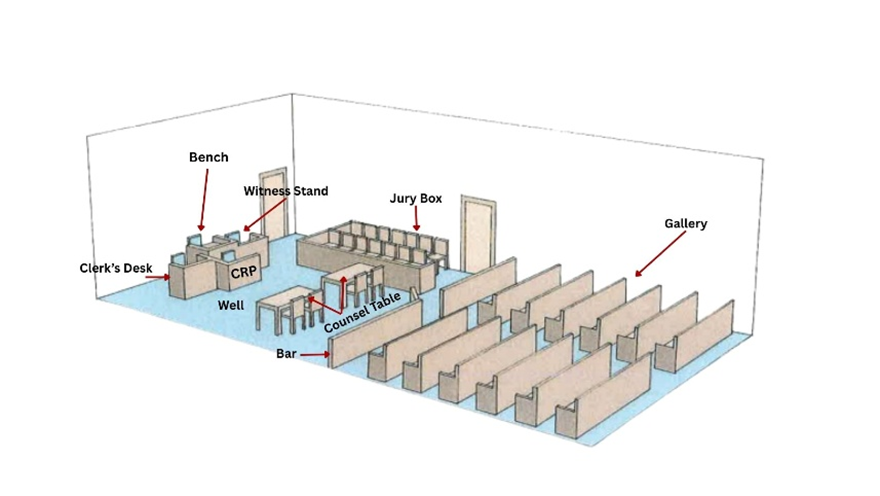
Bench – The judge sits on the bench and controls the trial, ensures the laws and rules are followed, and makes rulings.
Witness Stand – The witness sits on the witness stand to give testimony (tells the judge and jury what they know about the case).
Clerk’s Desk – The court clerk sits near the judge and helps the judge manage the courtroom and court documents.
CRP – The court reporting personnel (CRP) sits near the judge and keeps the official record of everything said in court.
Jury Box – Jurors sit here and listen to evidence before determining a verdict.
Counsel Tables – The prosecution or plaintiff sit at one table, and the defense sits at the other table.
Well – This is the center area between the bench and counsel tables where lawyers stand to question a witness, speak to the jury, and speak to the judge.
Bar – The bar is a physical barrier or railing that divides the courtroom into two areas: 1) inside the bar where only the judge, lawyers, court staff, parties, witnesses, and jury may be; and 2) outside the bar where the public sits to watch the trial (gallery).
Gallery – The gallery is where the public, media, and family members sit to watch the trial.
Jury Trial
The Nebraska State Bar Foundation has created a video to inform jury members on courtroom procedures, people involved in a trial, and responsibilities when sitting on a jury.
https://www.nebarfnd.org/civics-education/juror-orientation-video
You should not allow fear of criticism or retaliation to prevent you from doing your duty and rendering a just verdict. The full power and authority of the court will be used to protect you both during and after the trial. If you have a particular reason to fear for your safety, promptly inform the bailiff or judge.
Who are the trial participants?
A jury trial involves many people directly or indirectly. As a juror, you are an officer of the court who listens to all the evidence and arguments presented in a trial to reach a decision in the case.
The judge conducts the trial; rules on questions of law raised by the attorneys, and at the close of the trial, instructs the jury on the law that applies to the case.
The attorneys are employed by the parties or appointed by the court to advise the parties on the law and represent them at the trial.
The prosecuting attorney represents the State of Nebraska in all criminal cases.
Witnesses present testimony under oath, indicating what they have seen or know about the facts in a case. A witness may testify as an expert based on professional experience.
The clerk of the court is responsible for court records, summonses, subpoenas, collection of fines, and other court business. The court reporter transcribes a word-for-word record of all court testimony and proceedings.
The bailiff maintains courtroom order and assists the jurors.
What is the order of trial events?
A trial consists of a sequence of events in a specific order as determined by law.
OPENING STATEMENTS: Each attorney states his or her claim and may briefly state the evidence in support of the claim. The attorneys outline what they will show during the trial. Opening statements are not evidence. Opening statements are made to give you a general idea of what to expect when the evidence is introduced.
EVIDENCE: The plaintiff’s attorney presents evidence first. This is called direct examination.
The defendant has the right to examine this evidence. This is called cross-examination. Then the defendant’s attorney has the opportunity to present evidence.
Following the defendant’s introduction of evidence, the plaintiff has the right to cross-examine the witnesses presented by the defendant. The plaintiff has the right to present rebuttal evidence which can be cross-examined by the defendant’s attorney.
CLOSING ARGUMENTS: After all the evidence has been presented, the plaintiff’s and defendant’s attorneys argue their case to the jury. The closing arguments are not evidence.
What happens after the completion of testimony?
The judge will instruct you about the law regarding the case. You must base your decision making and discussion on the judge’s instructions regarding the law, rather than on your own idea of what the law is or ought to be.
You and the other members of the jury will retire to the jury room for deliberations and select one person to be the foreperson. He or she will preside at your deliberations and bring your verdict into court.
- Your deliberations should be characterized by a free and fearless expression of your own opinions and patient, tolerant attention to the opinions of others.
- While you must base your decision upon the evidence presented in the case, you should also keep in mind what the judge may have said about weighing the evidence, how to decide what evidence to believe, and the burden of proof. You must keep in mind all of the court’s instructions concerning the law.
- In many civil cases, you may have to determine whether there is any liability to pay damages and, if so, how much. It is suggested that you determine the issue of liability first, independently of the issue of the amount of damages. One reason for this is to avoid a compromise on the question of liability in exchange for a compromise on the amount of damages. Such a compromise would not be just and would violate your duty as a juror.
In a civil case, if the jury cannot reach a unanimous verdict within 6 hours of deliberations, then a verdict arrived at by 10 of a 12-person jury or 5 of a 6-person jury may be returned.
In a criminal case, jury deliberations conclude when a unanimous verdict has been reached. If after lengthy deliberations the jury is unable to agree on a verdict, the foreperson must notify the judge. The jury has nothing to do with sentencing the defendant if the jury returns a guilty verdict.
What happens after a verdict is reached by the jury?
Generally, when the jury has agreed on a verdict, the foreperson returns to the courtroom, where the verdict is given to the judge and read and recorded by the clerk.
All jurors must be present when the verdict is returned. You must keep your verdict secret until it is brought into court.
Do I have to tell anyone how or why I voted?
After the trial is completed and you are dismissed by the judge, you are not obligated to answer questions presented by attorneys or the press. If unwarranted questions persist, contact the judge immediately.
Grand Jury
The purpose of a grand jury is entirely different than that of a jury trial. A grand jury consists of 16 members and 3 alternates whose procedures are conducted in secrecy. A grand jury is asked to determine if criminal charges should be brought against an individual or individuals based on evidence presented during the grand jury. If the evidence is sufficient to recommend a criminal indictment the grand jury will find a “True Bill.” If the evidence is insufficient to recommend a criminal indictment a grand jury will find “No True Bill.” The decision to recommend a criminal indictment is normally made solely based on the state’s evidence and without the accused person having the opportunity to present his or her side of the case.
Grand Jury Secrecy Requirement
By law, the work of the grand jury is conducted in secrecy. Grand jurors take an oath which, in part, requires that they keep secret the work and discussions of the grand jury. Jurors must not discuss their investigation, deliberations or votes with anyone else unless specifically instructed to do so by the judge. Grand jury proceedings are conducted secretly for three reasons:
- Criminals who know a grand jury is investigating their crime might attempt to obstruct justice by intimidating witnesses or flee to avoid prosecution.
- Secrecy protects those who appear as witnesses from possible intimidation or threats.
- Secrecy protects innocent people whose names might come before the grand jury. A great injustice can occur if it becomes known that a person was investigated by a grand jury even if evidence was not sufficient for indictment.
Grand Jury Process
Individuals selected as grand jurors are given the rare opportunity and privilege of performing an important duty of good citizenship and service to the state.
A prosecutor or specially appointed prosecutor acts as the legal advisor and interrogates all witnesses who appear before the grand jury. Each juror has the right to question witnesses and may request that additional witnesses be called to appear before the grand jury for interrogation. Grand jurors also have the right to request specific documents or other evidence that might be helpful to an investigation.
During proceedings, grand jurors act as investigators of possible criminal conduct and act as judges in determining whether there is adequate evidence to charge individuals with criminal conduct. The obligation of secrecy requires that grand jurors not repeat, discuss or disclose the nature, content or result of their investigation and deliberation. They must not discuss any evidence, discussions, deliberations, opinions or statements made during the grand jury proceedings with anyone during the process or at any time in the future, unless called upon to do so in a court of law. They may not disclose or testify in court as to how they or any other members of the grand jury voted on any questions presented to them, or what opinions were expressed by any juror in their deliberations or investigation. Additionally, jurors are not allowed to disclose that an indictment has been found against a person until that person is in custody, is released under bail, or until the indictment is officially filed in the office of the Clerk of the District Court.
It is the foreperson’s job to see that proceedings are fairly conducted and that each member has a chance to question any witness, and to speak fully and freely on the issues in the case. A grand jury is not mandated to reach a decision within a set period of time, nor are they mandated to be sequestered. If jurors separate, they must abide by their oath of secrecy and not discuss the case with anyone, even with each other.
When a Grand Jury is Called
In Nebraska, grand jury requirements and procedures are found in the Neb. Rev.State. §29-1401. The law outlines three circumstances under which grand juries are to be called:
- JUDICIAL INITIATIVE – At the request of a district judge on an annual basis, or when the district court believes it to be necessary.
- IN CUSTODY DEATH – When a person has died while being apprehended or while in the custody of law enforcement officers or detention personnel. (In the case of an in-custody death, a grand jury is required.)
- PETITION – When a petition has been successfully submitted to the court.
The district courts (general jurisdiction court) of the State are the only courts with the power to call grand juries.
In Custody Death
A grand jury must be called when an individual dies while being apprehended by law enforcement or while in custody of detention personnel. In these cases, the purpose of a grand jury is to investigate the death to determine if formal charges should be made against any person for committing a crime in connection with the death.
Jurors consider the following:
- The cause of death.
- Whether there was any criminal conduct by any individual that caused or contributed to the death.
Grand juries may also make findings or recommendations which suggest that policies or procedures involved with the death be changed, or that new policies or procedures be instituted. Normally all investigations and decisions to prosecute or not prosecute individuals are the duty of the county attorney. With in-custody deaths, Nebraska law (Neb. Rev. Stat. §29-1401) requires the District Court to call a grand jury.
Officers of the Court
Grand jurors are officers of the court. It is a serious responsibility of citizenship and of the highest importance to the administration of justice and good government.
The power of a juror is great, and that power is to be exercised with care. It is the obligation of a grand juror to see that justice is done, while remaining mindful that the grand jury is designed not only to bring to trial those who are accused, but also to protect those who are innocent.
Employer Information Regarding Employee Jury Service
The Importance of Jury Service
The right to trial by jury is guaranteed by the United States Constitution and the Nebraska Constitution. The effective administration of justice depends upon citizens who are willing to serve as jurors when summoned.
Nebraska courts rely on employers to support this civic responsibility by allowing employees to fulfill their jury service obligations without penalty. Jurors are selected randomly, and their service is limited in duration.
Employers play an important role in supporting the judicial system by accommodating employees who are required to serve.
Temporary and “On-Call” Employees
All employees, including temporary or “on-call” employees, are required to report to court if they are served with a jury summons.
Employers are encouraged to provide reasonable scheduling flexibility so these employees may comply with their jury service obligations.
Length of Service and Daily Reporting
An employee summoned for jury duty may be required to serve for one day or several weeks, depending on the case and whether the employee is selected as a juror.
Employees may also be required to check in with the court daily to determine whether they must report for jury service that day. This process may continue for several days or weeks depending on the procedures of the court.
Employers and employees should make reasonable arrangements regarding returning to work if the employee is released earlier than expected.
Juror Compensation
Jurors receive $35.00 per day for each day of required service.
Employers may determine how juror fees are handled under company policy. Common options include:
- The employer continues paying the employee’s regular wages without regard to the juror fee.
- The employer deducts the juror fee from the employee’s wages.
- The employee signs over the juror fee to the employer.
- The employee waives the juror fee.
Juror compensation checks may not be issued until several weeks after jury service is completed.
Nebraska Law Protecting Employees (Neb. Rev. Stat. § 25-1674)
Nebraska law prohibits employers from penalizing employees for serving on jury duty.
An employee summoned for jury service may not be subject to:
- Discharge from employment
- Loss of pay
- Loss of sick leave
- Loss of vacation time
- Any other employment penalty
Employees who provide reasonable notice of a jury summons must be allowed to serve.
Employers may reduce an employee’s pay only by the amount of compensation received from the court for jury service (excluding expense reimbursements).
An employer who violates this statute may be guilty of a Class IV misdemeanor.
Supporting the Administration of Justice
The administration of justice requires careful consideration and fairness. By supporting employees who serve as jurors, employers contribute directly to the fair and effective operation of Nebraska’s courts.
Jury service is an important civic duty and often proves to be a valuable and educational experience for participating citizens.
Frequently Asked Questions
How long will I serve on a jury?
Your service on a jury depends upon the court’s need and the length of the trials in which you will be serving. Jury trials can vary from 1 day to several weeks.
Will I be paid for jury service?
For each required day you will receive $35 per day plus mileage.
How will I get paid?
The clerk of the court will submit your name and address to the county clerk, who will issue your check. If no mileage amount is submitted, the clerk’s office will figure the distance based on their map. Checks are generally mailed out between 2 and 4 weeks after your jury service has ended.
How should I dress for jury service?
Wear comfortable clothing which reflects the seriousness of jury service.
Will my employer allow me to take time off for jury service?
State law prohibits your employer from penalizing you. You cannot be fired, lose pay (except that your employer may reduce your pay by the $35 per day you receive for jury duty), lose sick leave, or lose vacation time.
You must give your employer reasonable notice that you have received a jury summons. Any person summoned must be excused by their employer, upon the juror’s request, from any shift work. If you want to provide your employer with information explaining jury service, print the information found in the Employer Information Regarding Employee Jury Service tab or send them a link to nejudicial.com/jury.
What should I do if I have an illness or an emergency during jury service?
Should an illness or an emergency arise during your jury service, inform the judge, bailiff or court clerk immediately and explain the situation.
Will I have to stay overnight?
Usually you will not be required to stay longer than the normal afternoon or evening adjournment time.
Occasionally, it becomes necessary to keep a jury overnight, which is called “sequestering the jury.” Should this happen, you may telephone a relative or friend to bring personal necessities. The court will pay for your meals and lodging.
Where do I park my car?
Most courts have both on- and off-street parking. Call the clerk of your court and check parking in your area.
What should I do when I report to the courthouse for jury service?
Check with the clerk of the district court’s office or follow the instructions on the jury summons.
What is my job as a juror?
Members of a jury are fact finders. Jurors are the sole judges of the credibility of the witnesses and must decide the value of the testimony of each witness. The jury must listen very carefully to all of the evidence and then decide the factual issues in the case.
May I take notes during the trial?
Nebraska jurors are permitted, but not required, to take notes during trials. Notes may be used during jury deliberations, but are confidential between the juror taking the notes and the other jurors. Court staff will destroy all notes immediately after the verdict is announced.
What is the difference between a civil case and a criminal case?
A civil case is a dispute between or among two or more persons or corporations in which the plaintiff asks the court to protect a right or to recover money or property from the defendant.
The plaintiff brings the case to the court. The defendant is the party being sued. When the defendant disputes the plaintiff’s claim, he or she files an answer to the plaintiff’s petition.
What if I am afraid to serve on a jury?
You should not allow fear of criticism or retaliation to prevent you from doing your duty and rendering a just verdict. The full power and authority of the court will be used to protect you both during and after the trial. If you have a particular reason to fear for your safety, promptly inform the bailiff or judge.
A criminal case is a trial brought in the name of the State of Nebraska against a person charged with violating the criminal law.
The State is represented by the prosecuting attorney. The person charged is called the defendant. Criminal cases are punishable by probation, fine, imprisonment, or death. The jury does not sentence the defendant. Sentences are imposed by the judge.